
Civil Technician
Overview
Assiniboine’s one-year Civil Technician certificate program trains graduates to carry out entry-level technical functions related to a broad range of civil engineering fields including structural, municipal, highway and transportation engineering, water resources, geotechnical engineering, environmental protection and infrastructure rehabilitation.
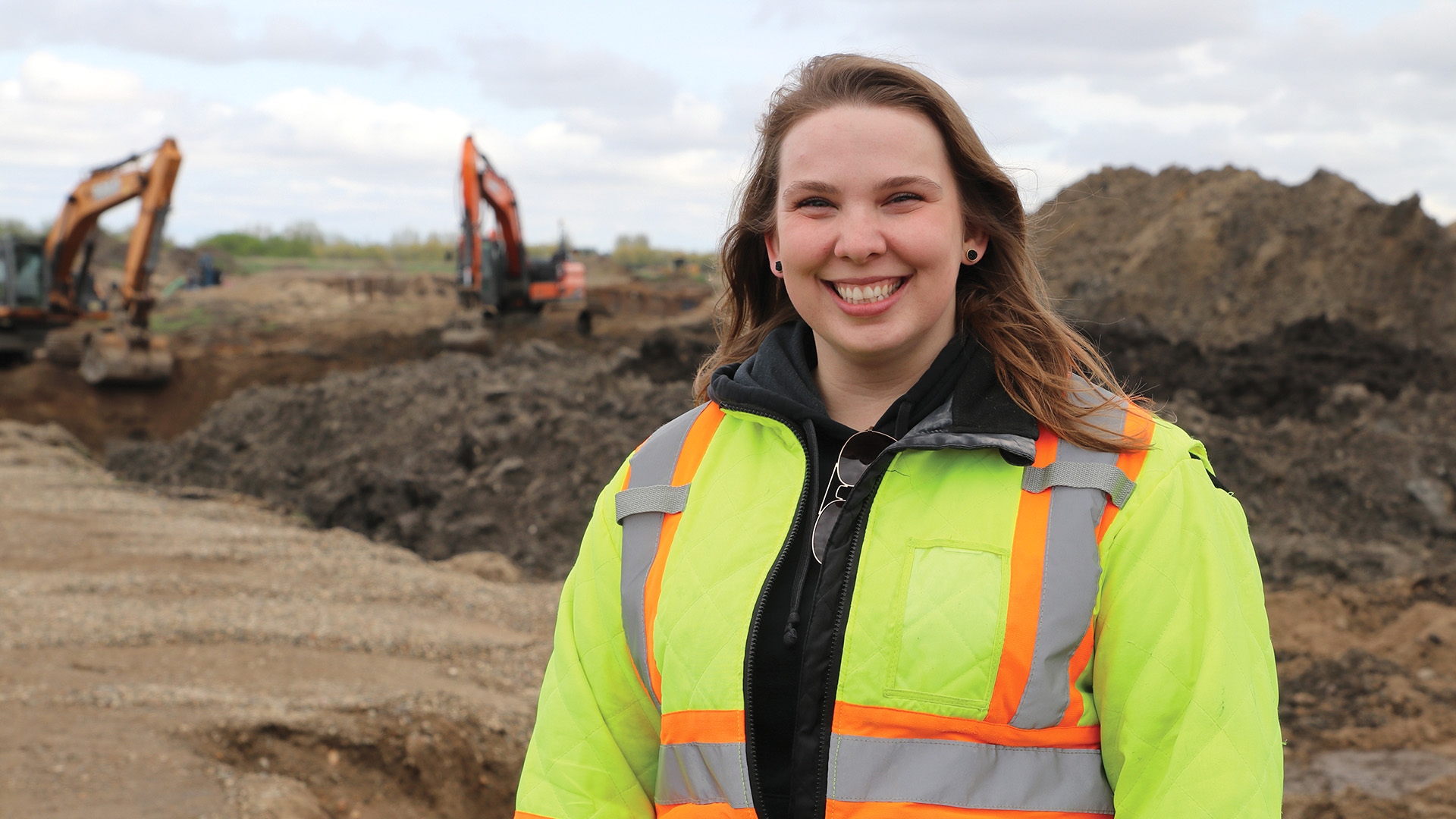
Civil technicians provide technical support and services to scientists, engineers and other professionals, or may work independently. As members of a multidisciplinary team, graduates work collaboratively with a range of project stakeholders to contribute to the accomplishment of civil engineering project goals in accordance with project plans, workplace health and safety practices, sustainability practices and all applicable laws, codes, industry standards and ethical practices.
Successful completion of the one-year Civil Technician program is a precursor to continuing on to the Civil Technology program, specializing in Municipal Engineering.
KEEP ME IN THE LOOP!
Fill out the form below to receive more information about our program and related events.
Program Learning Outcomes
- Participate in the design and modeling phase of civil engineering projects by applying engineering concepts, basic technical mathematics and principles of science to the review and production of project plans.
- Carry out sustainable practices in accordance with contract documents, industry standards and environmental legislative requirements.
- Collaborate with the project team and communicate effectively with project stakeholders to support projects
- Collect, process and interpret technical data to produce written and graphical project-related documents.
- Use industry-specific electronic and digital technologies to support projects, such as surveying or AutoCAD.
- Assist in the scheduling, cost estimation and monitoring of the progression of civil engineering projects by applying principles of construction project management.
- Perform quality control testing and the monitoring of equipment, materials and methods involved in the implementation and completion of projects.
- Apply teamwork, leadership and interpersonal skills when working individually or within multidisciplinary teams.
- Develop and use strategies to enhance professional growth and ongoing learning in the civil engineering field.
- Comply with workplace health and safety practices and procedures in accordance with current legislation and regulations.
- Complete duties and assist in monitoring that work is performed in compliance with contractual obligations, applicable laws, standards, bylaws, codes and ethical practices in the civil engineering field.
Examples of what jobs civil technicians can do:
- Graduates of Civil Technician programs work in a range of employment settings including municipal government engineering or operations departments, consulting engineering, civil construction and surveying firms.
- Graduates are typically employed in entry-level positions in the field as Computer-aided Design (CAD) operators, material testing technicians, surveying assistants, junior inspectors or estimators.
Success Factors
You might be a good fit for this program if you would enjoy:
- A one-year entry level program in an engineering related field
- Working in areas such as construction design and supervision, highways and transportation
- Good visualization skills, enjoys math solutions, and working with computers
- Planning, decision making and coordination of infrastructure projects
- Interested in drafting, surveying and modeling; road and highway analysis and municipal infrastructure design; concrete, soil and asphalt testing;
- A valid driver’s license and access to a vehicle is strongly recommended given the need to travel for co-op placement.
The industry and program environment require individuals to:
- Work in a variety of environments including laboratories, offices and industrial areas and working conditions may include a combination of indoor and outdoor work.
- Keep up with technological advances
- Tolerate environmental conditions, and potential hazards from heavy equipment construction materials when performing field work.
Interested in exploring similar program options?
We've got you covered! Here's another great program option to consider.
Admissions
Admission Requirements
- A complete Manitoba Grade 12 or equivalent
- English 40G/40S or equivalent
- Pre-Calculus or Applied Mathematics 40S or equivalent with a minimum mark of 65%
If you received your education outside of Manitoba, please review the equivalent admission requirements: Interprovincial or International.
English is the language of instruction at Assiniboine. All applicants educated outside of Canada or in a country not on the test exempt list are expected to meet the English language proficiency requirements.
READY TO TAKE THE NEXT STEP IN YOUR EDUCATION JOURNEY?
Start your online application today and join Assiniboine College!
DON'T MEET ADMISSION REQUIREMENTS?
If you don’t meet admission requirements, visit our Centre for Adult Learning to upgrade courses.
Careers & Connections
Career Opportunities
- Engineering and architectural firms
- Manufacturers
- Construction and development companies
- Inspection testing agencies
- Material suppliers
- Departments within government
Connections
Graduates of Assiniboine’s program may be eligible for advanced standing towards Red River College’s Civil Engineering Technology diploma program.
Assiniboine has a number of agreements with other colleges, universities and professional organizations, making it possible to apply credit taken at Assiniboine to programs at other institutions. For information on agreements, see Articulation Agreements.
Upon completion of this program, graduates will have the following certifications:
- Workplace Hazardous Materials Information System (WHMIS)
Tools & Supplies
Civil Technician students learn drafting fundamentals the traditional way and then learn AutoCAD applications. This, in turn, leads into designing houses, buildings and other structures that have real-world applications. Lectures, demonstrations and hands-on learning assignments are used before setting students loose on authentic assignments that follow real-world requirements.
Our classrooms, labs and shops are equipped with the necessary equipment that you need to make the most of your experience. However, there are some tools and supplies that you will need to purchase for personal use to help you with your studies. Much of what you purchase you’ll be able to use after you graduate and begin your career.
Program Checklists, Textbooks, and Supplies
Program Checklists:
Textbooks:
Supplies:
ASSINIBOINE BOOKSTORE
Textbooks, supplies and uniforms may be purchased at the Assiniboine Bookstore at the Victoria Avenue East Campus. Booklists are available from your school office 30 days prior to the start date of your program.
Technology Requirements
Students in this program are required to bring their own laptop for use on-campus. The laptop must meet the technical needs outlined by the program. MAC computing devices are not compatible with program software. See Technology Requirements for detailed information.
Courses & Costs
Costs
Estimated Program Costs (Domestic students)
| Credits | 72 |
| Tuition | $4,690 |
| Course Fees | $2,010 |
| Students' Association fees (including Health Premium) | $720 |
| Estimated textbooks, tools, and supplies | $1,820 |
All fees are estimated and subject to change without notice.
Estimated Program Costs (International students)
| Credits | 72 |
| Tuition | $20,420 |
| Course Fees | $2,010 |
| Students' Association fees (including Health Premium) | $720 |
| Required Health Insurance | $825 |
| Estimated textbooks, tools, and supplies | $1,820 |
All fees are estimated and are subject to change without notice. All international students must purchase health insurance. The college adds this fee to your student account and then sends your name and fee to the insurance provider on your behalf.
For more information, visit the Fees and Charges page.
Courses
To graduate with a Civil Technician certificate, students must successfully complete 72 credits. Graduates are eligible to continue with their studies in the Civil Technology - Municipal Engineering specialization diploma program at Assiniboine. The minimum passing grade for each course is indicated on the course outline.
Course offerings are subject to change and may vary by intake.
Courses
| Title | Credits/CEUs | Elective | Distance | PLAR |
|---|---|---|---|---|
Chemistry (SCIE-0098)This course introduces essential chemical principles relevant to civil engineering applications. Students explore topics such as chemical compounds and reactions, nuclear radiation, energy, gases, properties of solutions, acids and bases, and an introduction to organic chemistry and biochemistry. Emphasis is placed on understanding chemical behavior in materials, environmental systems, and construction contexts through both theoretical and practical learning. |
6 credit(s) | No | No | No |
Co-Op Work Placement - CIVTC (COOP-0041)Pre-Requisite: Cumulative grade point average (CWGPA) of 2.0 or greater. This course requires a minimum of 600 hours of full-time, paid related work experience. The work placement is subject to prior approval of and monitoring by a designated faculty member. Credit is based on successful completion of the work placement. Work experience acquired prior to registration in the program is not eligible for this credit. |
3 credit(s) | No | No | No |
College Foundations (PEDV-0356)This course improves students' ability to navigate the college experience and environment, including student's rights, roles, and responsibilities. In this course, students reflect on their skills, attitudes, and expectations and develop learning strategies to help them to become successful, resilient, and self-directed learners. The course covers topics such as success in online learning, time management strategies, learning strategies, assessment taking strategies, academic integrity, information and digital literacy, and wellness, among others. It integrates elements of student orientation. |
0 credit(s) | No | No | No |
Engineering Math 1 (MATH-0148)This course introduces foundational mathematical concepts essential for civil engineering technology. Students develop problem-solving skills through practical applications in construction, surveying, and design. Topics include algebraic operations, trigonometry, ratios, proportions, and basic geometry such as area, perimeter, and volume. Emphasis is placed on interpreting and analyzing real-world scenarios relevant to the civil field. |
6 credit(s) | No | No | No |
Engineering Math 2 (MATH-0149)This course introduces foundational mathematical concepts essential for civil engineering technology. Students develop problem-solving skills through practical applications in construction, surveying, and design. Topics include algebraic operations, trigonometry, ratios, proportions, and basic geometry such as area, perimeter, and volume. Emphasis is placed on interpreting and analyzing real-world scenarios relevant to the civil field. |
6 credit(s) | No | No | No |
Environment, Ethics & Society (ENVR-0020)Gain insight into the importance of sustainable development and the impact of technology and industry on the environment and society. Students discuss various moral theories and techniques that can be used to resolve ethical dilemmas. Professionalism is promoted through the examination of the Engineers Geoscientists Manitoba (EGM) and Certified Technicians & Technologists Association of Manitoba (CTTAM) Code of Ethics and other documents that are the basis for the professional exam required for Engineering Technologists seeking certification in Manitoba. |
3 credit(s) | No | No | Yes |
General Safety Training (WRKP-0035)This course covers basic general safety content to provide students with core information necessary for them to protect themselves in the workplace. Although some examples used in the training may consider Manitoba legislation, this course has been developed using generic information that is not province-specific. |
0 credit(s) | No | No | No |
Geomatics 1 (GEOS-0027)This course introduces students to data collection and mapping related to Global Navigation Satellite Systems (GNSS), and drone technologies. Students examine coordinate systems, datums, projections, satellite constellations, and theories related to Geographic Information Systems (GIS). Emphasis is placed on the proficiency in operating a variety of GPS equipment, data collection, data accuracy, documentation, and processing. |
3 credit(s) | No | No | No |
Geomatics 2 (GEOS-0028)This course explores the principles, theories and analysis techniques related to Geographic Information Systems (GIS) applications. Using fundamental GIS concepts, students explore a variety of spatial datasets. Students investigate the relationship of spatial data and workflows between GIS applications and AutoCAD. |
3 credit(s) | No | No | No |
Job Skills Development (PEDV-1012)Through a series of seminars, students build the skills necessary to secure and maintain employment. Topics will include resume writing, interview preparation and skills, networking, and understanding the workplace. |
0 credit(s) | No | No | No |
Statics 1 (MECH-0166)This course deals with the basic concepts of statics as applied to the analysis of frames and the determination of centroids and the moment of inertia of geometric bodies. This is the basis of all building and bridge construction. A good understanding of these principles is necessary in all aspects of civil engineering. As a civil engineering student, it is important that an understanding of these principles is achieved since these concepts are constant in application. |
6 credit(s) | No | No | No |
Statics 2 (MECH-0167)This is a basic course in strength of materials, which includes stress and deformation in deformable bodies. Moment of inertia calculations for simple and complex shapes are included along with shear and moment calculations, and diagrams for structural beams. Demonstrations of materials testing illustrate the physical behaviour of engineering materials. |
6 credit(s) | No | No | No |
Surveying 1 (ENGR-0001)Students become familiar with survey equipment and its use, including horizontal measurement, levelling, calculation and measuring angles and topographic surveys. |
6 credit(s) | No | No | No |
Surveying 2 (ENGR-0009)Prerequisite: ENGR-0001 Surveying 1 |
6 credit(s) | No | No | No |
Technical Graphics 1 (COMP-0686)This is a basic course in strength of materials, which includes stress and deformation in deformable bodies. Moment of inertia calculations for simple and complex shapes are included along with shear and moment calculations, and diagrams for structural beams. Demonstrations of materials testing illustrate the physical behaviour of engineering materials. |
6 credit(s) | No | No | No |
Technical Graphics 2 (COMP-0687)This advanced course builds on the foundational skills developed in Technical Graphics 1, focusing on the application of CAD tools in civil, architectural, and mechanical design. Students deepen their understanding of 2D drafting and explore introductory 3D modeling techniques, layout creation, and file management for professional documentation. Emphasis is placed on industry standards, precision, and workflow efficiency using current CAD software to produce detailed technical drawings for real-world engineering projects. |
6 credit(s) | No | No | No |
Technical Reading and Writing (COMM-0429)This course teaches clear, accurate and concise technical writing and reading for various technical fields. Students learn how to organize technical information, illustrate documents, write routine work requests, close work orders, letters and memos, prepare instructions, produce a simple user manual and effectively read technical materials. Students also learn how to prepare and deliver tehnical briefings and presentations such as safe work pre-job briefs. |
6 credit(s) | No | No | No |
Fast Facts