


Business Administration
Financial Services Specialization
Overview
Step into Canada’s thriving financial services industry and become the expert your clients trust. This program equips you with the critical skills to make a lasting difference in their financial futures.

Assiniboine's two-year Business Administration program is accredited by the Accreditation Council for Business Schools and Programs (ACBSP), an international quality assurance body, adding another layer of distinction to its offerings. This accreditation is assurance that you are enrolled in a program that meets globally recognized standards for business education, guaranteeing the highest quality of instruction and curriculum relevance. As a graduate of Business Administration, you can be confident in your qualifications, which will provide you with a competitive advantage in the job market and equip you with the skills needed for success in today’s dynamic and ever-changing world of business.
Program Learning Outcomes
Graduates are able to:
- Apply problem-solving and critical thinking skills to effectively respond to challenges and opportunities in business.
- Collaborate with others toward fulfillment of a shared vision, goal, initiative, or project.
- Collect, analyze, and interpret data to make informed decisions.
- Demonstrate effective communication by selecting and utilizing suitable methods tailored to diverse situations.
- Determine the ethical implications of business decisions, considering the potential impacts on stakeholders and society.
- Integrate environmental sustainability, social responsibility, and governance principles to enhance and drive an organization’s strategic business initiatives.
- Provide customer service and solutions that meet and exceed stakeholder expectations.
- Leverage technology to meet organizational needs.
- Implement comprehensive strategies to achieve specific personal and corporate financial objectives.
- Use current financial planning software to analyze and present information.
- Apply relationship building skills to gather information, inform decisions and provide long term financial advice.
- Provide investment and portfolio management advice through
- understanding investment strategies, risk management and asset allocation.
Success Factors
You might be a good fit for this program if you would enjoy:
- Helping individuals and businesses achieve their financial goals
- Building relationships and supporting business growth
- Analyzing information to guide financial decisions
- Using technology to deliver efficient financial services
- Solving problems and working with numbers
The industry and learning environment require individuals to:
- Demonstrate strong attention to detail and accuracy
- Show solid numerical and financial aptitude
- Apply analytical thinking and sound judgment
- Communicate clearly and build trusted client relationships
- Support business development through client service and sales activities
- Act with integrity and uphold ethical and regulatory standards
- Use financial and digital tools confidently
- Stay organized and manage competing priorities effectively
- Commit to continuous learning and professional development
- Be comfortable working in both desk-based and client-facing environments
Admissions
Admission Requirements
- A complete Manitoba Grade 12 or equivalent
- English 40G/40S or equivalent
- Essential Mathematics 40S or equivalent
If you received your education outside of Manitoba, please review the equivalent admission requirements: Interprovincial or International.
English is the language of instruction at Assiniboine. All applicants educated outside of Canada or in a country not on the test exempt list are expected to meet the English language proficiency requirements.
Start in January. Graduate sooner.
Students starting in January will complete their Business Administration program in just 16 months–continuous study through four consecutive terms to help you get be career-ready sooner.
ALREADY HAVE A DEGREE OR DIPLOMA? GO A STEP FURTHER.
Fast-track your education journey and take advantage of one of our Advanced Diploma programs.
DON'T MEET ADMISSION REQUIREMENTS?
If you don’t meet admission requirements, visit our Centre for Adult Learning to upgrade courses.
Careers & Connections
Career Opportunities
A Financial Services diploma prepares graduates for entry-level roles in banking, investments, insurance, and customer financial advising. Common career opportunities include financial services representative, banking advisor, credit analyst assistant, insurance agent, and investment or wealth management assistant. Graduates find employment in banks, credit unions, insurance companies, investment firms, and other financial institutions, where they support clients in managing their finances, accessing credit, and planning for future goals.
The program also supports career advancement in areas such as personal financial planning, lending, and investment advising. It provides graduates with the foundational knowledge needed to pursue industry-recognized certifications and helps prepare them to meet related licensing and work experience requirements. With experience or additional credentials, graduates can move into roles such as financial advisor, account manager, or branch manager. This diploma offers practical, job-ready skills and a strong foundation for long-term career growth in the financial services sector.
Connections
The Business Administration diploma program is accredited by the Accreditation Council for Business Schools and Programs (ACBSP), an international quality assurance body. For more information, see the ACBSP Accreditation tab.
Assiniboine has a number of agreements with other colleges, universities and professional organizations, making it possible to apply credit taken at Assiniboine to programs at other institutions. For information on agreements, see Articulation Agreements.
Tools & Supplies
Program Checklists, Textbooks, and Supplies
ASSINIBOINE BOOKSTORE
Textbooks, supplies and uniforms may be purchased at the Assiniboine Bookstore at the Victoria Avenue East Campus. Booklists are available from your school office 30 days prior to the start date of your program.
Technology Requirements
Students in this program are required to bring their own laptop for use on-campus. The laptop must meet the technical needs outlined by the program. Mac computing devices are not compatible with program software. See Technology Requirements for detailed information.
Courses & Costs
Estimated Program Costs (Domestic students)
| Financial Services | Year 1 | Year 2 |
|---|---|---|
| Credits | 60.0 | 60.0 |
| Tuition | $3,870 | $4,930 |
| Course Fees | $1,200 | $870 |
| Students' Association fees (including Health Premium) | $640 | $640 |
| Estimated textbooks, tools, and supplies | $1,210 | $1,110 |
All fees are estimated and subject to change without notice.
Related licensing fees for BUSN-0170 Financial Planning and BUSN-0160 Canadian Investment Funds are included in the tuition costs above and will be paid to IFSE Institute and/or Canadian Securities Institute by the college on your behalf.
Estimated Program Costs (International students)
| Financial Services | Year 1 | Year 2 |
|---|---|---|
| Credits | 60.0 | 60.0 |
| Tuition | $16,790 | $17,850 |
| Course Fees | $1,200 | $870 |
| Students' Association fees (including Health Premium) | $640 | $640 |
| Required Health Insurance | $825 | $825 |
| Estimated textbooks, tools, and supplies | $1,210 | $1,110 |
All fees are estimated and subject to change without notice.
All international students must purchase health insurance. The college adds this fee to your student account and then sends your name and fee to the insurance provider on your behalf.
Related licensing fees for BUSN-0170 Financial Planning and BUSN-0160 Canadian Investment Funds are included in the tuition costs above and will be paid to IFSE Institute and/or Canadian Securities Institute by the college on your behalf.
For more information, visit the Fees and Charges page.
Courses
To graduate with a Business Administration diploma, students must successfully complete 120 credits. The minimum passing grade for each course is indicated on the course outline. Course offerings are subject to change and may vary by intake.
Year One Courses
| Title | Credits/CEUs | Elective | Distance | PLAR |
|---|---|---|---|---|
College Foundations (PEDV-0356)This course improves students' ability to navigate the college experience and environment, including student's rights, roles, and responsibilities. In this course, students reflect on their skills, attitudes, and expectations and develop learning strategies to help them to become successful, resilient, and self-directed learners. The course covers topics such as success in online learning, time management strategies, learning strategies, assessment taking strategies, academic integrity, information and digital literacy, and wellness, among others. It integrates elements of student orientation. |
0 credit(s) | No | No | No |
Communications (COMM-0006)This course develops students' basic communication skills and provides them with strategies needed to communicate effectively: orally and through written media. Course topics include the process of communication, communicating across cultures, characteristics of effective messages, and composing effective written messages. |
6 credit(s) | No | Yes | Yes |
Economics 1 (ECON-0006)This introductory course in economics acquaints students with some of the basic principles of economics, including economic activity, the theory of prices and output under various degrees of competition, and application of these theories. Income distribution and resource allocation are also included. |
6 credit(s) | No | Yes | Yes |
Financial Accounting 1 (ACCT-0003)This introductory course in the fundamental principles of accounting provides a basic understanding and application of principles relating to the accounting cycle and current assets. |
6 credit(s) | No | No | Yes |
Financial Accounting 2 (ACCT-0004)Prerequisite: ACCT-0003 Financial Accounting 1 |
6 credit(s) | No | Yes | Yes |
Human Resource Management (HRMG-0036)This participative course provides an overview of the field of human resource management from the perspective of both the employer and the employee. Students will learn the skills and strategies needed to compete effectively in the job market as well as gain an understanding of the roles and responsibilities of the human resource function within an organization. |
6 credit(s) | No | Yes | No |
Marketing Principles (MKTG-0044)This course provides students with an understanding of the basic marketing skills that are required by employers for success in today's competitive marketplace. Students gain a basic understanding of the role of marketing in society and business, types of markets, the marketing environment, the elements of the marketing mix and the development of marketing strategies and plans. |
6 credit(s) | No | Yes | Yes |
Math for Business (MATH-0107)This course reviews basics mathematics and introduces fundamental concepts used in financial analyses to develop skills for solving practical problems encountered in business. It provides a base for all specializations. |
6 credit(s) | No | Yes | No |
Organizations and Management (BUSN-0168)This course develops students' knowledge of behaviour science theory and concepts useful in organizations related to personal behaviour, group behaviour, teamwork, leadership, organizational culture and organizational change. The four managerial functions of planning, organizing, leading and controlling will also be examined. Practical exercises will illustrate concepts. |
6 credit(s) | No | Yes | No |
Personal Management (PEDV-0322)This course is a skills-based course, designed to improve personal and professional competencies in the areas of self-assessment, supportive communication, conflict management, decision-making, stress management, influencing others, goal setting and teamwork. |
6 credit(s) | No | Yes | No |
Software Applications (COMP-0597)In this introductory course, students develop the fundamental computer skills necessary in business. Students learn how to manage their files on a network and utilize techniques to improve data security. Students use text processing software to create, format and share a variety of documents including memos, letters, one-page publications, reference lists and long documents. Students also prepare spreadsheets that incorporate various formulas and functions, formatting techniques, 'what-if' options to enhance data analysis and data integrity features. Lastly, students prepare effective electronic presentations using presentation software. |
6 credit(s) | No | Yes | No |
Year Two Courses
| Title | Credits/CEUs | Elective | Distance | PLAR |
|---|---|---|---|---|
Business Capstone (BUSN-0167)Prerequisite: COMM-0386 Research and Report Writing |
6 credit(s) | No | No | No |
Canadian Business and Society (BUSN-0166)Students explore the complex business environment and the relationships organizations have with civil society, the natural environment and each other. Through this examination, students learn that ethical decision-making is critical to the successful management of any organization. Topics include changing economic, political, social and cultural forces and their influences on business and society; the continuum of socially responsible management and ethical business practices; and the challenges and opportunities that influence where an organization fits on the continuum. Special attention is given to Indigenous history and developments. |
6 credit(s) | No | Yes | No |
Canadian Investment Funds (BUSN-0160)Prerequisite: ECON-0006 Economics 1 |
6 credit(s) | No | No | No |
Corporate Finance (BUSN-0165)Prerequisite: ACCT-0004 Financial Accounting 2 |
6 credit(s) | No | Yes | No |
Economics 2 (ECON-0007)Prerequisite: ECON-0006 Economics 1 |
6 credit(s) | No | Yes | Yes |
Financial Planning (BUSN-0170)Prerequisite:BUSN-0169 Personal Finance |
6 credit(s) | No | No | No |
Life License Qualification (BUSN-0256)Prerequisite: BUSN-0169 Personal Finance |
6 credit(s) | Yes | No | No |
Personal Finance (BUSN-0169)Students use current financial planning software to support the financial plans created for clients. Students use the software to outline and deliver financial plans, which cover such topics as inflation, historical returns, comprehensive and periodic retirement goals, major purchase goals, education goals, insurance goals, capital growth, RRSPs, payouts from RRIFs and LRIFs, and loan and mortgage calculations. This course also uses a real time investment simulator (Investopedia.com) model to teach the principles of investing in the financial markets. The course uses a case study to provide the student experience in portfolio management through the creation of a diversified portfolio. The course culminates with the student presenting the portfolio to the instructor in an interactive fashion. |
6 credit(s) | No | No | No |
Professional Selling (MKTG-0065)Prerequisite: MKTG-0044 Marketing Principles; COMM-0006 Communications |
6 credit(s) | No | No | No |
Research and Report Writing (COMM-0386)Prerequisite: COMM-0006 Communications |
6 credit(s) | No | Yes | No |
Taxation 1 (BUSN-0171)Prerequisite:ACCT-0004 Financial Accounting 2 |
6 credit(s) | No | Yes | No |
ACBSP Accreditation
The Business Administration diploma program at Assiniboine has been accredited by the Accreditation Council for Business Schools and Programs (ACBSP).
By choosing Assiniboine College for your Business Administration diploma, you not only add value to your education and skillset but also demonstrate a high level of professionalism and commitment to your future success.
Student Advantages
ACBSP accreditation provides assurance of the quality and relevance of the educational experience, which can be highly beneficial for students for the following reasons:
Quality Assurance
Accreditation signifies that the business program meets rigorous standards of quality and excellence in business education. This assurance is important for students who want to receive a high-quality education and acquire relevant skills.
Transferability of Credits
Many students transfer from two-year programs to four-year universities or colleges. Completing a diploma in an accredited institution can simplify the process of recognizing and accepting credits from other educational institutions.
Employer Recognition
Having a degree or diploma from an accredited institution can enhance your job prospects and career advancement opportunities. Employers value this because it indicates that you have received a thorough and rigorous education.
Curriculum Relevance
Regular reviews of Assiniboine's Business Administration program guarantee that they stay up-to-date and responsive to the demands of the business world. As a result, you'll have a greater chance of discovering the most recent industry trends and best practices.
Faculty Quality
We attract and retain high-quality faculty members who are experts in their fields. This translates to the benefit of learning from experienced and knowledgeable instructors.
Networking Opportunities
We have strong connections with local businesses and industry leaders. This provides you with valuable networking opportunities, co-ops and practicums, and job placement assistance.
Enhanced Learning Environment
We are committed to creating a conducive learning environment that supports student success. Discover numerous helpful resources such as libraries, research facilities, and various support services aimed towards ensuring your success as a student.
Personal Satisfaction
Knowing that you're attending a school with a recognized accreditation can boost your confidence in the value of your education, leading to increased personal satisfaction and motivation to excel academically.
Global Recognition
We are recognized internationally, which is valuable if you plan to work or study abroad in the future.
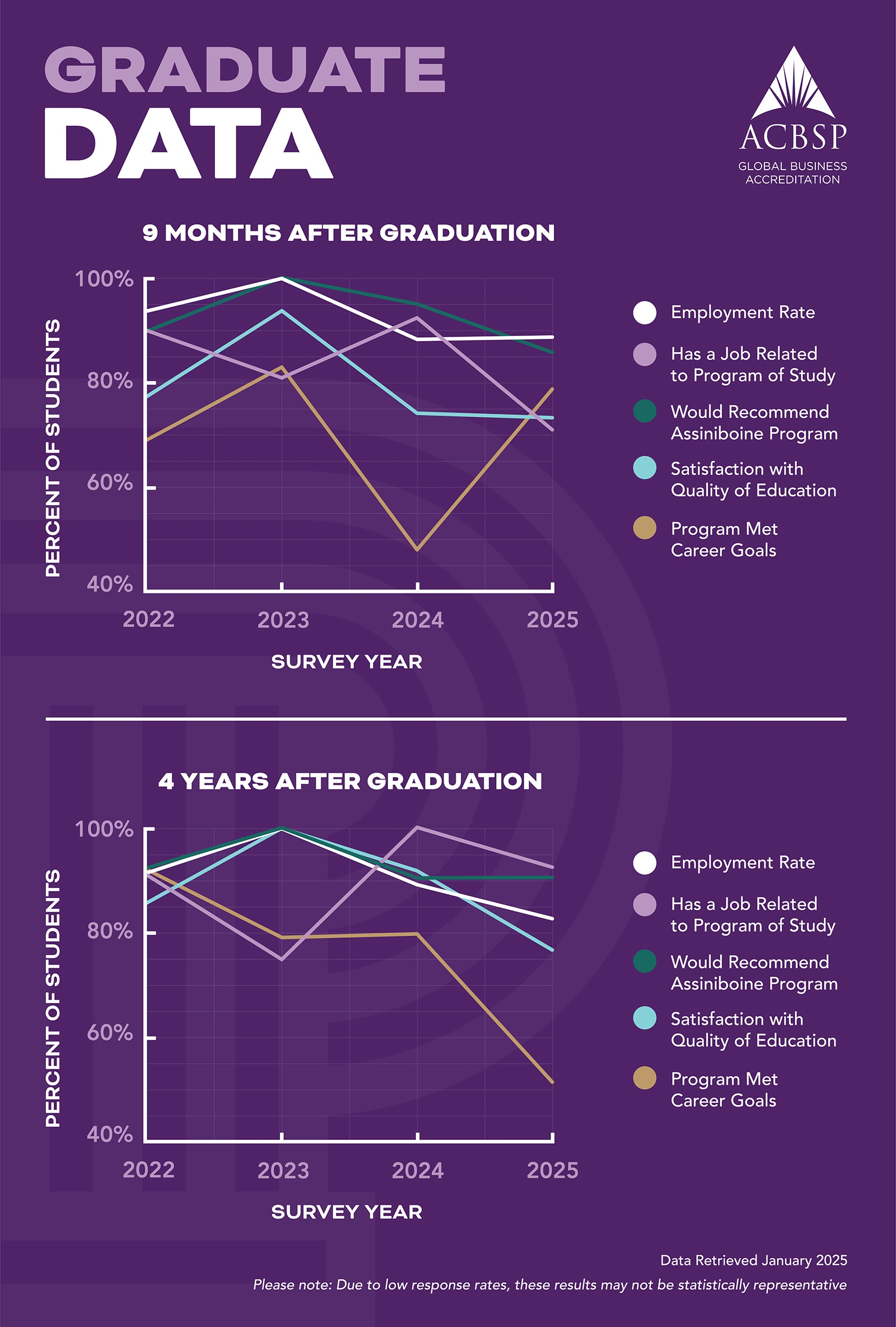
Download Student Achievement Spreadsheet (Table 7.1)
Continuous Improvement
In the spirit of continuous improvement, the Peters School of Business has renewed its commitment to Program Advisory Committees—drawing on industry feedback, student surveys, and faculty input. These perspectives guide our Program Renewal process, ensuring alignment with current industry standards and reinforcing our learn-by-doing approach. In parallel, the Peters School of Business Strategic Plan is being developed for completion by the end of 2025. This plan will set out a clear vision and roadmap for the future, created with the involvement of all stakeholders, including staff, faculty, students, and the community.
Distance Education
The Business Administration diploma program is an in-person, on-campus, day program. Select courses are available for active students to take by distance, dependent on need. To see when courses are being offered throughout the year, the costs and how long you have to complete them, click on the schedule below.
The deadline to register is the 20th of the month prior to the specific course start date however, you can register at any time – you don’t need to wait for the deadline. For example, for February 1st courses, the deadline to register is January 20th.
If you are interested in the full program, applications are currently being accepted for the full-time, on-campus, day program.
Please note, payment is required at the time of registration.
Registration options:
Active Student
- If you are an active Assiniboine student in the Business Administration diploma program, complete the registration form below and email it to [email protected]. Payment must be made at the time of registration.
Not an Active Student
- If you are not an active Assiniboine student in the Business Administration diploma program, but you are interested in taking a few courses, you may do so up to a maximum of 12 credits. Complete the registration form below and email it to [email protected].
Some assessments, such as tests and exams, may require invigilation. In these cases, students are responsible for making their own invigilation arrangements, and any associated fees are the student’s responsibility.
In-Person Invigilation Only:
Assiniboine College’s Test Centre does not offer virtual or online proctoring. All exams must be written in person under the supervision of an approved invigilator.
- Students near Brandon or Dauphin:
You can book an in-person exam at one of Assiniboine’s Test Centres. - Students outside the area (elsewhere in Canada):
You must write your exam at a recognized testing location that offers in-person invigilation services. We recommend using Athabasca University’s Canada-wide list of approved invigilation sites to find an appropriate site near you. Please note that while we use this list as a resource, Assiniboine does not offer virtual invigilation like Athabasca does.
Policies
Please ensure that you review our academic policies, including policy A20: Refunds, Registration, Adding and Dropping of Courses, which explains the refund policy for distance education courses; and A10: Maintaining Active Student Status, which details how often you need to complete a course to remain active in your program. You have five years to complete a program.