All ITS services will be unavailable between 7 and 9 a.m. CDT on Sunday, October 25.
Read more

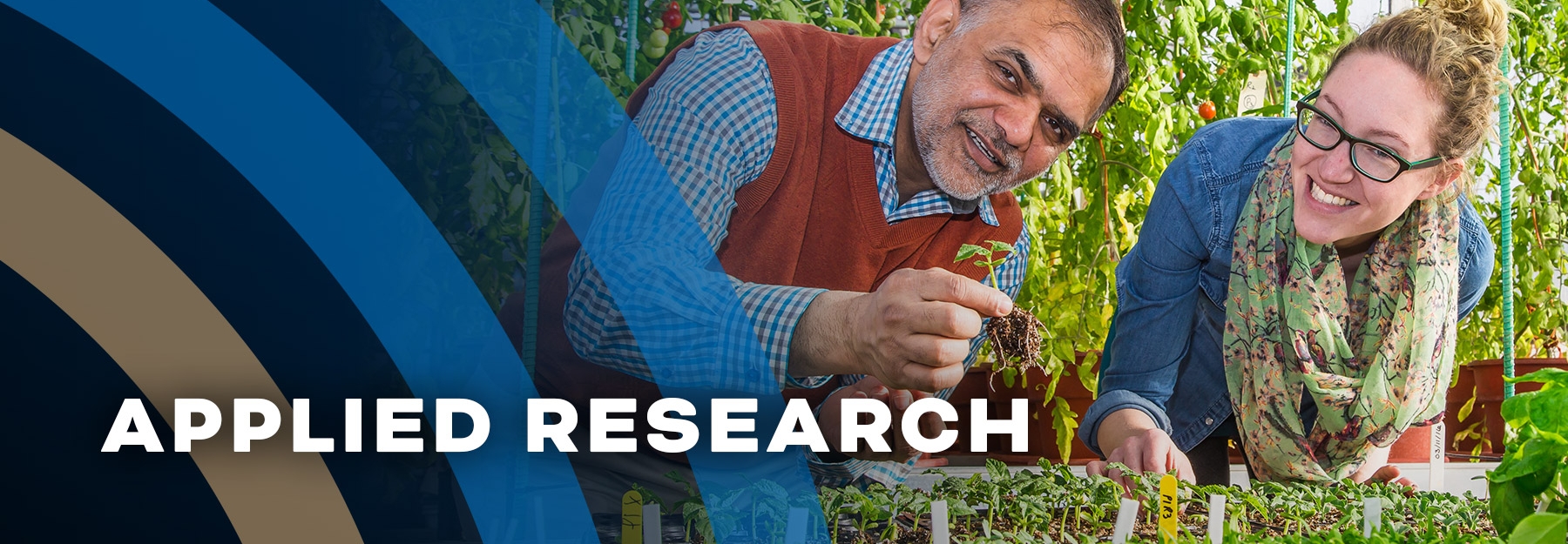
Applied Research
Russ Edwards School of Agriculture & Environment has been offering agricultural, horticultural, and environmental programs for more than 45 years. The Faculty of Agriculture and Environment is renowned for its comprehensive training in agriculture and horticulture, producing skilled graduates who excel in these fields.
Beyond education, the faculty is recognized as a premier applied research institution in Manitoba, contributing significantly to advancements in agricultural practices, sustainable horticulture, and environmental stewardship. Through collaborative projects and innovative research, Assiniboine College continues to lead in addressing the challenges and opportunities in the agricultural sector.
Meet Our Research Team
Meet the dedicated researchers at Edwards School, where innovation and expertise drive impactful discoveries and advancements in various fields, and explore the innovative research projects and initiatives driving advancements in technology, sustainability, and community development.
Advancing Agriculture and Food Systems
Edwards School research focuses on crop sustainability, pest management, protein sources, and clean technologies, addressing industry and regional food production challenges. Collaborative efforts enhance food self-reliance, environmental sustainability, and economic growth. Supported by prestigious grants, these initiatives culminate in the Field-to-Fork cluster, uniting expertise to improve food security and community health.
Given the urgent issues associated with the impact of climate change on sustainable food production systems and increasing global food insecurity, Assiniboine's ultimate goal is to research and develop innovations to support industry sustainability across the food production value chain while preparing students to meet workforce needs. From environmentally safe, high-quality inputs to sustainable harvesting practices and production systems using clean technology, Assiniboine’s expertise in the agricultural, and horticultural sector, is invaluable to creating viable future national and global systems.
Applied research at Edwards School aims to discover, interpret, apply, and disseminate knowledge in response to problems relevant to its industry partners. Outcomes can include the development of new knowledge and technologies, new or enhanced product designs, and/or improved processes or services which improve business productivity and competitiveness. Sector needs are identified through extensive discussions with Assiniboine's partners in industry, academia and government. Assiniboine uses integrated planning to respond to industry challenges, and to monitor the economic, environmental, and ecological trends affecting Manitoba and Canada. Edwards School uses interdisciplinary approaches to explore crop health, integrated pest management and bio-control systems, extension agriculture, and learning projects designed to increase awareness of community resilience and ecological conservation issues.
Soil Health and Sustainability
Environment AND Conservation
Wireless and IoT
The foundations of digital agriculture solutions include data collection and analytics; Machine Learning (ML) and Artificial Intelligence (AI) implementation of control, based on data; and autonomy. The team’s research explores reliable and ubiquitous wireless connectivity in a rural environment, while responding to the food security and environmental sustainability needs of agricultural producers, agribusinesses, system integrators, and technology solution providers.
Development, testing and implementation of ML and AI to support crop management decision-making in real time will improve productivity and reduce operating costs and food security through higher yields, and environmental sustainability through decreased environmental footprints. Research in ML and AI will move Digital Ag to Smart Ag, where decisions are being made without the operator being involved, reducing manpower and eliminating possible errors. To build a meaningful end-to-end solution, the college will work with, and incorporate, several of these technologies with a plan to specialize in one or two areas, in partnership with industry.
The tools and instruments acquired by the college to support digital agriculture research activities include unmanned aerial vehicles (UAVs or drones) with various capabilities, GIS/GPS equipment, sensors, instrumentation for machine-to-machine and Internet of Things (IoT) development, radiofrequency equipment, greenhouse environmental monitoring and management systems, and a wide range of bench and portable equipment.
Greenhouse and covered crop production
Applied research to address needs of greenhouse horticultural producers, fruit and vegetable growers, growers’ associations, nursery propagators, and plant material producers. Providing affordable, flexible crop production and management options outside typical growing seasons, will impact local and regional food production capacity and food security, particularly for Indigenous communities in the North; and reduce fossil fuel consumption impacting the environment and sustainability of small-scale growers and farmers in the local food production system.
Research exploring local media replacement options for peat such as sawdust/tree wood fibers, compost, and fish fertilizers. This will impact climate change mitigation, production costs, and environmental sustainability.
Research benefiting sustainable food production innovation, especially in northern and Indigenous communities where arable land is scarce and food insecurity is critical. Research will explore affordable clean technology heating options to extend capacity for food production in year-round growing environments; address climate change mitigation needs with high- and low-tech solutions to optimize plant-growing conditions, quality, and yield; and examine the influence of “closed greenhouse” environments on crop productivity for energy savings, reduced CO2 emissions, and reduced pest pressures and water requirements. This work will realize significant and sustainable impacts on food security and the environment.
Crop production and protection
Research will fulfill the innovation needs of a top economic driver within the agricultural sector. Research will ensure stability and market growth through the development of improved crop pest management strategies; and advances in soil and soil fertility, forages, and crop agronomy on field crops to design more cost- and yield-effective field practices building soil health and protecting the land, water, and air from environmental contamination.
Memberships & Affiliations
- Enterprise Machine Intelligence and Learning Initiative (EMILI)
- Manitoba Beef & Forage Initiative- Research Advisory Board
- Manitoba Diversification Centres-Provincial Advisory Committee (PAC)
- Manitoba Industry-Academia Partnership (MI-AP)
- Manitoba Potato Science and Technology Strategy
- Manitoba Protein Consortia
- Protein Industries Canada
- Research Manitoba-Board of Directors
- Team Manitoba-Research Security
- Vermillion Growers-Advisory Board
Partners
academic partners:
- Brandon University
- Kwantlen Polytechnic University BC
- Olds College
- Ontario Tech University
- Saskatchewan Polytechnic
- University of Manitoba
- University of McGill
- University of Winnipeg
academic association:
- CiCan-Colleges and Institutes Canada
Local, provincial and federal government departments:
- Agriculture/Agri-Food Canada's (AAFC)
- Brandon, MB
- Morden, MB
- Portage La Prairie, MB
- City of Brandon
- City of Morden
- Govt of MB-Department of Agriculture
- Govt of MB-Natural Resources & Northern Development-Fish & Wildlife
- NRC Industrial Research Assistance Program (NRC IRAP)
Indigenous groups:
- ATEC-Atoskiwin Training and Employment Centre of Excellence
- Manitoba Metis Federation
- Sioux Valley Dakota Nation
for-profit companies:
- Agri-Skills Inc.
- Ag-Quest/Minto BioProducts Ltd.
- Atom-Jet Industries
- Brandon Fresh Farms
- Bushel Plus ltd.
- Carbon Lock Technologies
- Decision Works - Industry - Digital AG
- Enns Brothers
- Farmer Hive's
- Garo Foods BC
- GreenSpot Nurseries - Brandon MB
- Harvest Today
- Hespler Farm Winkler MB
- Hylife Foods
- Infinite Harvest
- Innovative Heating Technologies Inc.
- Jeffries Nurseries Ltd -Portage MB
- Jonique Farms
- K & C Solar Solutions
- Koch Fertilizers
- Manitoba Pork
- Maple Leaf Foods
- Mayfair Farms – Portage MB
- Myera Group Inc.
- North Star Agriculture
- Peak of the Market
- Prairie Mountain Hops (Manitoba)
- Ramo (Quebec)
- Ronin Agronomy
- Rourke Farms
- Shelmerdine Garden Centre Ltd
- Smilie Worms Organic Farms
- South East Research Farm
- T&T Seeds Ltd.
- Terra-Wave Radar Solutions
- Typha Co.
- Vanderveen's Greenhouse Lid.
- Vermillion Growers
industry associations:
- Farm Management Canada
industry-government consortiums:
- Manitoba Association of Watersheds
- Manitoba Canola Growers Association
- Manitoba Crop Alliance
- Manitoba Forage & Grassland Association (MFGA)
- Manitoba Horticulture Productivity Enhancement Centre (MHPEC)
- Manitoba Landscape and Nursery Association (MLNA)
- Manitoba Pulse & Soybean Growers (MPSG)
- Prairie Fruit Growers Association (PFGA)
- Vegetable Growers Association of Manitoba
- Whitemud Watershed District
not-for-profit companies:
- Canadian Council on Invasive Species
- International Peace Garden
- Manitoba Beef & Forage Initiative (MBFI)
- Manitoba Diversification Centres
- Manitoba Crop Diversification Centre (MCDC-Carberry)
- Parkland Crop Diversification Foundation (PCDF-Roblin)
- Prairies East Sustainable Agricultural Initiative (PESAI-Arborg)
- Westman Agricultural Diversification Organization (WADO-Melita)
- Protein Industries Canada
- Vineland Research and Innovation Centre
- YBUSA-YouthBuild USA
Relevant Documentation
Connect with us.
Are you a business, not-for-profit or community group that needs help solving a problem or addressing a market gap? Reach out to see if we can help.